-
Are You Media Literate?

What is Media Literacy?
Media Literacy is the ability to access, analyze, evaluate, create, and act using all forms of communication.
Why is Media Literacy Important?
Think about how communication has evolved just in the last 50 years. Growing up in the 70s, there were no cell phones, no home computers, no internet (so no streaming), and most homes had only one phone line that everyone shared (and the phone was on a cord!). Our daily news and entertainment were accessed through newspapers, magazines, radio, television (there were only about thirteen channels then…not much to choose from), and neighbors. If you wanted to watch a specific program, you had to be home when it was on since VCRs didn’t come out until the late 70s (and were way too expensive for most of us at that time). Oh yeah, and television stations actually signed off the air at night!

Unlike today, with our 24/7 access to information and entertainment. We can stream almost any program or movie we want to watch nearly instantly (it can sometimes take a few minutes to figure out which streaming platform has the program you’re looking for), create and publish our own media content (ahem, blog post), and we walk around with smart devices that give us access to news from all over the world as it’s happening.
This increased access to all of this media bombarding us all the time makes it necessary to learn how to pick through all the stories in search of truth, rather than misinformation and disinformation.
Media Literacy Basics
When it comes to media literacy, there are some key questions that should always be asked of any information you are taking in (especially if you believe what is being said).
- Who is the author of this piece of media?
- How does this benefit them?
- What is the purpose of this piece of media?
- How are they trying to influence me?
I hate to say this, but in today’s world of disinformation and misinformation we have to be critical of just about everything we read, see, or hear.
Media Ownership and Regulation
This video gets me every time. Dozens of TV anchors from Sinclair Broadcast Group recited the same speech warning against “biased and false news” parroting then-President Trump’s diatribe about mainstream media being “fake news.” When one company (or just a handful) owns so much of the media, what we get is going to be anything from fair and balanced. Most in the media literacy community do not want tech companies like Google, Facebook, Twitter, etc. regulating what content can be shared and who is allowed to share it, with some exceptions. These would mostly be in reference to hate speech, but this can be a slippery slope with who gets to decide where speech goes from being considered “rude” to “hateful” and what the original intent is/was. There is also Section 230 of the 1996 “Communications Decency Act” which established that online services (like FB, Twitter, Tik Tok)) cannot be held liable for what users say on their platforms… most of the time. There is debate about whether the evolution of media necessitates revisiting this law.
Media Privacy and Security
In our media-heavy society, with a streaming device in virtually everyone’s hand and cameras everywhere, what was once our private life can now end up being very much public. This has led to what is known as The Right to be Forgotten, which gives individuals the right to ask organizations to delete their personal data. There are requirements that must be met to be forgotten:
- The personal data is no longer necessary for the purpose an organization originally collected or processed it.
- An organization is relying on an individual’s consent as the lawful basis for processing the data and that individual withdraws their consent.
- An organization is relying on legitimate interests as its justification for processing an individual’s data, the individual objects to this processing, and there is no overriding legitimate interest for the organization to continue with the processing.
- An organization is processing personal data for direct marketing purposes and the individual objects to this processing.
- An organization processed an individual’s personal data unlawfully.
- An organization must erase personal data in order to comply with a legal ruling or obligation.
- An organization has processed a child’s personal data to offer their information society services.
Organizations can deny this request for the following reasons:
- The data is being used to exercise the right of freedom of expression and information.
- The data is being used to comply with a legal ruling or obligation.
- The data is being used to perform a task that is being carried out in the public interest or when exercising an organization’s official authority.
- The data being processed is necessary for public health purposes and serves in the public interest.
- The data being processed is necessary to perform preventative or occupational medicine. This only applies when the data is being processed by a health professional who is subject to a legal obligation of professional secrecy.
- The data represents important information that serves the public interest, scientific research, historical research, or statistical purposes and where erasure of the data would likely to impair or halt progress towards the achievement that was the goal of the processing.
- The data is being used for the establishment of a legal defense or in the exercise of other legal claims.
Misinformation, Disinformation, Hoaxes, and Conspiracies
Let’s Put some definitions in this section to help you learn the differences:
Misinformation – false information that is spread, regardless of intent to mislead.
Disinformation – used more generally to mean deliberately misleading or biased information; manipulated narrative or facts; propaganda.
Hoax – to trick into believing or accepting as genuine something false and often preposterous: something accepted or established by fraud or fabrication.
Conspiracy – a secret plan made by two or more people to do something that is harmful or illegal: the act of secretly planning to do something that is harmful or illegal
Advertising and Propaganda
Advertising and propaganda are two of the strategies used by individuals, groups and even organizations to influence the behavior of others in favor of the advertiser or propagandist. Although the two terms are often used interchangeably, they have different meanings, usage and objectives.
Advertising refers to the activity of developing advertisements for the purpose of attracting the attention of the public towards a particular product or service. On the other hand, propaganda is a kind of promotional tool that is biased in nature and has the objective of promoting a specific set of ideas based on the vested interest of the propagandist.
Public opinion is shaped by the media around us, and when it comes to propaganda, the government is excellent at it. What the government refers to as public relations is, after all, just a form of propaganda. Check out this video from Crash Course on public opinion:
Representation in Media
Diversity is still a bit of a struggle within most media. There continues to be the cliched stereotypes of country bumpkins, fat people are lazy, black men are thugs, Jewish men are penny-pinchers, I could keep going, but I’m pretty sure you’ve got the idea. And, holy cow, look at the increase in hate crimes aimed at Asian-Americans after Trump referred to continually referred to Covid-19 as the “China virus” and “kung flu!” Definitely an example of the negative power of the media.
There may be more diverse ethnic representation when it comes to news programs and talk shows, but even these are still predominately white. To be truly inclusive in our society, we need to represent everyone, not just who the media decides is “sellable.”
All this instant information is creating an overload that most people don’t want to try to wade through. There will always be a need for scrutiny, but by knowing how to be intelligent media consumers, maybe we can slow this insidious infiltration of misinformation and conspiracy theories…or maybe I’m just overly optimistic.
-
Imagine the Future
It may seem like a cop out to turn to Star Trek as a window to the future, and a mirror on our current struggles, but it has had such an impact over the years and continues to address social issues in a fantasy setting, even now, that it remains a relevant media resource for inspiring change. Star Trek “has been, and always shall be” about diversity from the very first episode. In the 1960s it was unusual to have a mixed race cast, let alone having a woman a part of the command crew, but Star Trek took that on right from the first episode.
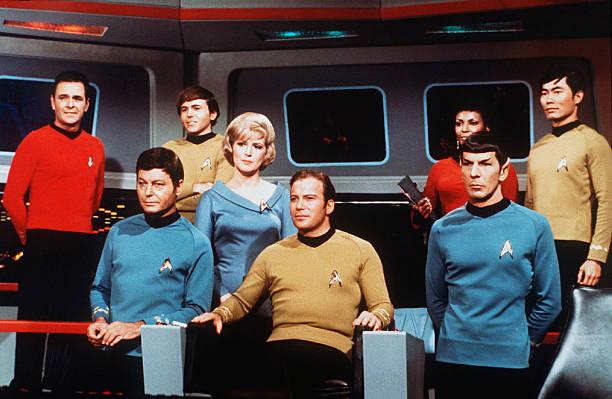
On the set of the TV series Star Trek (Photo by Sunset Boulevard/Corbis via Getty Images) Racism is an issue that comes up often in both the original series and current ones (does that tell you that we still have a problem with this?!).
In Star Trek VI: The Undiscovered Country, during a dinner between the Enterprise crew and a delegation from a Klingon vessel, one of the Enterprise crew comments about believing everyone has certain inalienable human rights…then is told off by a member of the Klingon delegation…“Human rights? The very name is racist.”
The most recent iteration of the franchise, Star Trek Discovery, hits heavy on the themes of racial purity, isolationism, racism, immigration and other contemporary issues, with the aim of prompting people to take a good, long look at the world. The series is mainly set around the war between the Federation and the Klingons, but an interesting take on how the war started has to make us wonder about our dealings with other cultures. What right do we have to interfere with another culture, and why do we think ours is always superior?

-
You Don’t Know Me
So Don’t Judge Me
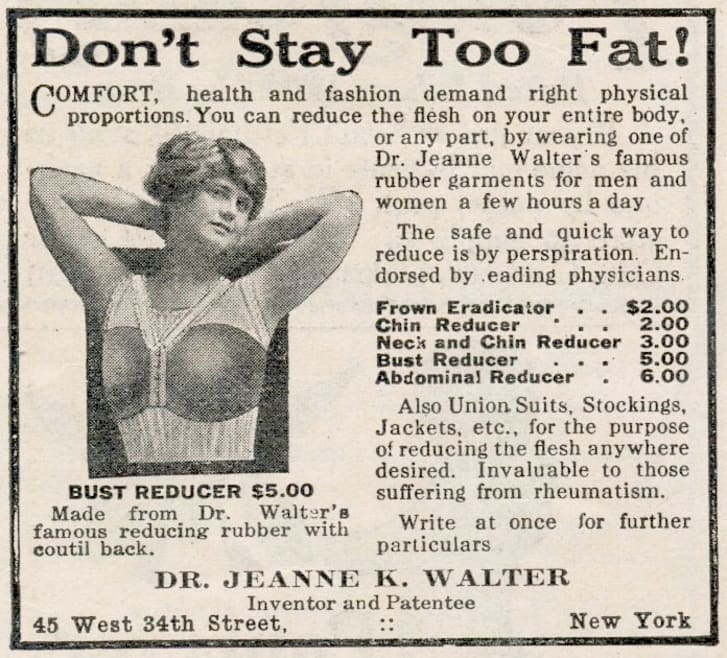
Advertisement from the late 1800s preying on insecurity about gaining weight When you see someone who is overweight in the grocery store bakery section perusing the donuts or picking out a cake, what is the first thing that pops into your mind? Most of you would probably not admit this in a group, or maybe you would, but I’m thinking it’s something along the lines of “Oh, please, no, no, no, just put it back. That is the last thing you need!” I know because I’ve had things like this said to me, but what’s worse is that I’ve also thought them myself about others, even though I know better.
By looking at that person’s size, and judging them based solely on that, you assume they are the stereotypical fat person; only eats junk, hates themselves, depressed, no self-control, slow, lazy, unattractive; and why not? That’s what media has taught us to believe pretty much since the beginning of print.
But why? This is probably someone you’ve never met and know absolutely nothing about. So, why does society generally feel that it’s ok to assume that they are a lesser person (and treat them as such) because of their body size?
The sitcom Mom had one of their characters, Jill, develop an eating disorder, then put her in a fat suit, to hide her pregnancy. In an interview, the actress playing Jill talked about how they handled the eating disorder issue with great sensitivity, however by the end she makes the comment “There’s a big elephant in the room and that elephant is Jill.” That shows how little sensitivity and understanding was actually put into that storyline. There could have been other ways to account for her pregnancy without having her eat everything in sight, transferring her alcoholism to food, which isn’t an equal transfer. You can be an alcoholic and live the rest of your life without drinking any alcohol, but you can’t live the rest of your life without food.

As a species, humans have a tendency to seek the approval of others in their group. By being seen as something other than normal (fat, ugly), or perceiving oneself as such, it is extremely difficult to be seen for the person that you are. This leads to low self-esteem and a negative body image, especially among young females.
There is even a movie called The Duff, duff being a derogatory slang term for the “designated ugly fat friend.” The lead in this movie is cast to be someone of average appearance and normal proportions, telling every girl watching it that if they are average than they are “ugly and fat.” The target audience for this movie is teen girls, who are also the most vulnerable about body image. How many girls have lost some of their self-esteem after watching this movie because they are wondering if they are the duff in their group of friends?
While there has been a large push for body positivity, we still have a long way to go.
-
A Brief Look at Book Banning and Burning

Book banning has been around as a practice for centuries. The earliest known book burnings are mentioned in the Hebrew Bible (Jeremiah 36), then the burning of Confucian works (and execution of Confucian scholars) in Qin Dynasty China, 213-210 BC. From the 16th century, during the Roman Catholic Counter-Reformation against the Protestants, attempts for non-clergy to read for themselves was seen as a dangerous threat to the church.

In his article The History of Book Banning, author and historian of literacy Harvey J. Graff noted “Once led by the established church, censorship crusades to ban written materials of all sorts are today supercharged by right-wing politicians, radical evangelicals, and supporting activists.” I find it incredulous that book banning still exists as a practice today, though now it is often used as a political tool, with organizations like the American Library Association fighting to keep these tomes intact.
In the early days of book banning and burning, the tactic was to keep the ignorant masses ignorant. The church could keep control of their flock by only giving them information approved by the church, and preventing their citizens from becoming educated. Nowadays, different political, religious, and activist groups use fear in attempts to ban books. Much of the banned material relates to real lives, real situations, and real people, but opponents of this material spout that it will damage our kids, put dangerous ideas in their minds (this is mostly in relation to LGBTQ+ subject matter), and (God forbid) teach them that racism is real.
https://www.vox.com/policy-and-politics/22914767/book-banning-crt-school-boards-republicans
Much like the church’s attempts to control the ideology of the masses, many conservative and fringe groups want to control our kids and keep them from thinking for themselves. We need to be critical thinkers, acknowledge our differences, and not hide from reality.
-
Verify Before Sharing!
In today’s world of instant information, it is our own responsibility to check that the information we are reading, believing, and sharing is accurate. We all have a tendency to believe whatever stories we read that align with our own values, but we need to look beyond that, to whether what we are reading is actually factual, or if it has been skewed to fit the view of the person posting/reading it.
Let’s take a look at this piece of skewed information that I found through Reuters Fact Check:
When reading a post like this, one of the first things to look at is the source. First of all, just the fact that this was forwarded by Rudy Giuliani is a big red flag to me, but to a Trump supporter they will most likely see him as reliable, just like the US Patriots which “is a fellowship of Americans who abide by the Constitution of the United States and believe that our rights come from God” (mostly extremely conservative, anti-science posts).
Reuters dug into the original ruling and debunked that this had anything to do with a person receiving an mRNA vaccine. The Court ruled that synthetically created complementary DNA (cDNA) is patentable, while isolated natural DNA is not, and also that per the US Patent Act “no patent may issue on a claim directed to or encompassing a human organism” meaning that a patented medical treatment or device does not make a human any less human. If that were the case, anyone who has ever had a stitch or a filling would be considered trans-human.
Let’s have a look at this post. Facebook has already flagged it, but if they hadn’t what do you need to look for? The only link in the post is to the court document, so that’s ok, but they didn’t actually quote from it, they created their own misunderstanding of the results and stating it as fact with no corroborating proof. Not to mention, if you actually try to search for information on this “trans-human” creation, you will pretty much get articles from fact checking sites debunking it, like this one:
The most important tool in disseminating online information is research. Even when I read something from a website that I generally trust, I will look for another source for confirmation.
-
Week 3 Media Diary
3:00 am – Alarm clock goes off, I roll over and hit snooze. Seven minutes later it goes off again, and I turn it off.
3:30 am – 4:30 am – Back-up alarm set with Alexa goes off, and I tell Alexa to snooze. I pick up the TV remote and turn on a random program that I’ve seen many times, (currently Night Court https://www.imdb.com/title/tt0086770/ ) for background noise to help me wake up and check my phone for any messages. Alexa goes off again, usually while I’m brushing my teeth, which makes telling her to turn off the alarm a bit more difficult. When I get downstairs, I turn on the TV in the dining room for background noise (usually continuing whatever I was watching in my bedroom) while I make and eat breakfast. At 4:15 am I head to my vehicle and leave for work, usually with the radio turned up and tuned into an 80s station. Most of the ads I recall hearing had to do with online education and erectile disfunction (what a combo!). I sit in the parking lot playing solitaire on my phone while I wait for my coworker.
4:30 am – 11:00 am – Work. There is a sound system in the store (no advertisements, just music) that a couple of us like to switch to 80s or Disco so the upbeat music helps keep us moving and shaking. On my break/lunch I am usually reading through Smart News posts on my phone or playing a game on a platform that I paid a small subscription fee for so that I do not get ads.
11:00 am – 12:pm – Getting in my vehicle after work, radio on as always, I check my phone for any messages or important notifications. I then head to Grocery Outlet where I am tortured by their overhead sound system blaring country music (with an occasional ad for their store). The receipt includes a coupon for my next visit and a reminder to sign up for email offers. Then back into my vehicle, with my radio, and head home.
12:00pm – 4:30 pm – Upon getting home I am now on childcare duty with my 4-year-old grandson (Covid-related issues caused him to not have preschool this week, ugh).

It’s January and he’s still wearing his Halloween costume. This results in the TV being on child-friendly shows to help keep him entertained when we are not actively playing together. I used to think Barney was the worst thing ever, until I was subjected to Baby Shark!!! The show doesn’t really teach much, except maybe that Baby Shark has lots of friends (that you can buy and play with), and has no real educational content. Several times during this 4½ hr time span, I try to log on to my computer to work on my homework, however my grandson’s radar is keen and as soon as I touch the keyboard, he climbs into my lap so that I can’t type. While he sits on my lap, I will play games (usually Microsoft Solitaire or Puzzle Page, both of which I have ad-free subscriptions to), read Smart News, or attempt a video or reading assignment on my phone. Around 4:30 his mom gets home and I am off to start dinner.
4:30 pm – 6:00 pm – I pull up Hello Fresh on my phone app to read through the cooking directions for tonight’s meal. Several times I get reminders from the app that I have free boxes I can “send” to my friends so that they can try the service for themselves. Other than the Hello Fresh app, I’m not really paying attention to other media that’s on, but there is a TV on in the living room for the child, his mom is reading a book on her phone, the child is ignoring the TV and playing a PBS Kids game on his phone (it’s an old cell phone with no sim card so can’t make calls and only works with wifi), and my teenage son is playing something VR in his room. When dinner is done, they all descend upon the kitchen, dish up their food, then go back to their devices. After I dish myself up, I put the leftovers away and watch a show in the dining room while I eat. Tonight it’s an old episode of Rowan and Martin’s Laugh-In. It amazes me that many of the issues from the 60s and 70s that this show brought up are still issues today (racism, voting rights, women’s rights, government accountability), and that some episodes were mildly prophetic (in the segment “News of the Future” for 1988 they mention President Reagan, in reference to then California Governor Reagan who was, indeed, president 1981-1988.
It’s about 5:30 into this clip
6:00 pm – 9:00pm – This is finally my homework time. I log on to my laptop to access my class content. This includes accessing my school, online news articles, scholarly articles (through ASU or Google Scholar), recorded lectures, YouTube videos, and search engines. Everything I’m access during this period is school related.
9:00 pm – 3:00 am – I fall asleep (hopefully) watching Futurama and/or playing solitaire on my phone. I can’t explain how it happened, but I seem to have programmed myself that Futurama = sleep, so the only time I can watch it now is if I want to nap or it’s bedtime.

I will admit that this is not necessarily an ordinary day of usage for me. Based on this I’m a pretty low target for information. They can figure out from my streaming that there is probably a grandparent/grandchild living here. On a more typical day I’m likely to wander over to Amazon, where I will get lots of targeted advertisements either for things I am currently searching or things I (or my kids) have previously searched. The fact that I use their Subscribe and Save service also creates more targeting in things their algorithms think I might be interested in adding to my subscription based not only on current subscriptions but previous searches. I try to tell myself that I don’t fall prey to targeted advertising, but I am also well aware of my tendency to impulse shopping, which is what many of those targeted ads are counting on.
-
NAMLE’s definition of media literacy:
“Access is how, when, where, and how often people have access to the tools, technology, and digital skills necessary to thrive.”
How we access our digital lives is extremely dependent on net neutrality. Although “nothing bad” has happened, yet, that does not preclude something on the horizon. This may not be as bad as the doom and gloom originally predicted, but let’s imagine what the future of media would look like if a few big corporations were in control of all of our media (assuming no antitrust lawsuits are filed that actually win).
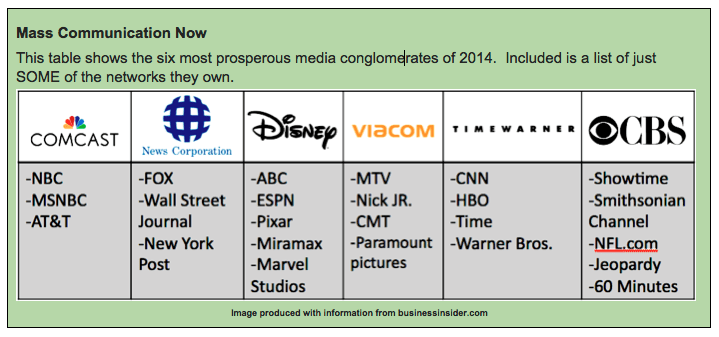
I know the chart above is a bit outdated now, but roll with me (it’s just a prop and this is all hypothetical). Let’s say a multinational conglomerate, like Comcast, acquired Zoom Video Communications. If there were no net neutrality regulations in place, you could be required to have their internet services in order to have Zoom access. So, for your work to have a group meeting on Zoom (or your family to have a Zoom birthday party for the 99-year-old matriarch), every single employee (or family member) has to subscribe to that particular ISP, leaving many unable to attend, or having to pay large fees for temporary access. Oh, and by the way, they also control all the news feeds on your phone/internet browsing, so you will only see news and events that they want you to see (like some dictatorship governments do).
Customer: “I’m trying to log in to xxxxx.com to download a project I was working on, but I keep getting an ‘access to this site denied’ notification.”
ISP: “I’m sorry, that company was purchased by our rival and you can no longer access their website through our services. For an additional $1000 fee we can have all of your data transferred to our new site at yyyyy.com, or you can switch to our rival and we will charge you $2000 for early termination. Have a nice day.”

Yes, I know that’s a bit of an extreme example, but think about how the internet would look if it was only the rich elite that had a voice. Net neutrality comes with responsibility. We can’t be so naïve as to believe what we read/see/listen to without checking the validity of those statements, but we also can’t be afraid to read ideas that we may not agree with, especially statements that come from sources with high credibility.
While working on this assignment I ended up in a discussion with my son (he’s 18) about net neutrality. His immediate opinion was the same argument many use, “nothing bad has happened yet, so why worry about something that may not happen?” (I don’t think he realizes that we live in a state that has maintained a certain amount of net neutrality). I mentioned that the large ISPs needed to make upgrades to their infrastructure for their fast lanes to be feasible, which have been under construction for the last couple of years. So, then I asked, “Now that they are mostly ready to launch, how do you know that we aren’t about to see the changes that were warned about?” He really didn’t like me making him think about it, and pretty much could only come back with the same argument that if nothing bad has happened yet, then it’s not going to.
How about “Although nothing bad has happened yet, why couldn’t it?” Getting down to only six or so major conglomerates running everything isn’t that likely to happen, but I like the take on it that I read in this article from the Entertainment Strategy Guy.
I’m not saying anything catastrophic is going to happen, but why wait until it’s too late to fix it when we can keep some safeguards up instead?
-
If Only I Knew What I Was Doing!
Welcome to the introductory post for my blog. My name is Cyndi and I am a Nutrition major in my senior year. I am a widow currently living in Oregon with my two adult children and my grandson.

Our trip to Zoolights a couple of years ago. (The one with the beard is my grandson’s dad.) Since my Nutrition degree is heavy on communication, I felt that taking this class would enhance my abilities to communicate safely in any medium that will be the best fit for my future clients. Coming from an older generation, digital media hasn’t come as naturally to me as it does for my kids, but I’m getting there!
-
Subscribe
Subscribed
Already have a WordPress.com account? Log in now.
 Cyndi's Media Class